

Irish art has a rich history shaped by dramatic landscapes, political change, rural traditions, and everyday life.
From the romantic medieval scene of Frederic William Burton’s The Meeting on the Turret Stairs to the expressive paintings of Jack B. Yeats, Irish artists have created works that capture both the country’s history and its distinctive character.
Famous Irish Paintings
1. The Meeting on the Turret Stairs – Frederic William Burton, 1864

The Meeting on the Turret Stairs is one of the best-known works in Irish art.
Frederic William Burton depicts a secret meeting between two medieval lovers, Hellelil and Hildebrand, whose relationship is destined to end tragically.
Painted in watercolor and gouache, the work is admired for its remarkable detail, rich colors, and restrained emotion.
The lovers barely embrace, making the scene feel intimate and sorrowful rather than theatrical.
2. The Liffey Swim – Jack B. Yeats, 1923

Jack B. Yeats captures the excitement of Dublin’s annual swimming race along the River Liffey. Crowds gather beside the water to watch the swimmers, creating a lively snapshot of Dublin life.
Yeats was particularly interested in ordinary people and public events. The energetic composition of The Liffey Swim helped make it one of his most recognizable paintings and an important image of early twentieth-century Ireland.
3. Men of the South – Seán Keating, 1921–1922

Seán Keating’s Men of the South portrays a group of armed men during the Irish revolutionary period. Rather than depicting an active battle, Keating shows the figures waiting together in a rugged landscape.
Their serious expressions and still poses create a feeling of tension and uncertainty. The painting became closely associated with the struggle for Irish independence and remains one of Keating’s best-known works.
4. The Blind Piper – Joseph Patrick Haverty

Joseph Patrick Haverty’s The Blind Piper is one of the best-known nineteenth-century Irish genre paintings. It depicts a blind traditional musician seated with his pipes, presenting its subject with a combination of realism and quiet dignity.
The painting reflects a growing interest in depicting ordinary Irish people, traditional customs, and rural life. Haverty’s careful treatment of the musician also gives the work value as a visual record of Irish cultural life during the nineteenth century.
5. A Convent Garden, Brittany – William John Leech, c. 1913

William John Leech spent considerable periods working in France, where he was influenced by Impressionism and Post-Impressionism. Those influences can clearly be seen in A Convent Garden, Brittany.
Bright sunlight passes through dense foliage, creating patches of brilliant color across the scene. The painting demonstrates Leech’s particular talent for capturing light and remains one of the most recognizable works of his career.
6. The Goose Girls – Sir John Lavery, 1889

The Goose Girls was painted during Sir John Lavery’s time at the artists’ colony of Grez-sur-Loing in France. The painting depicts young girls tending geese in a peaceful rural landscape, combining everyday subject matter with Lavery’s growing interest in painting outdoors.
The soft natural light and loose brushwork show the influence of plein-air painting on Lavery’s early career. The work demonstrates the developing style that would eventually help establish him as one of the most prominent Irish painters of his generation.
7. The Potato Diggers – Paul Henry, 1912
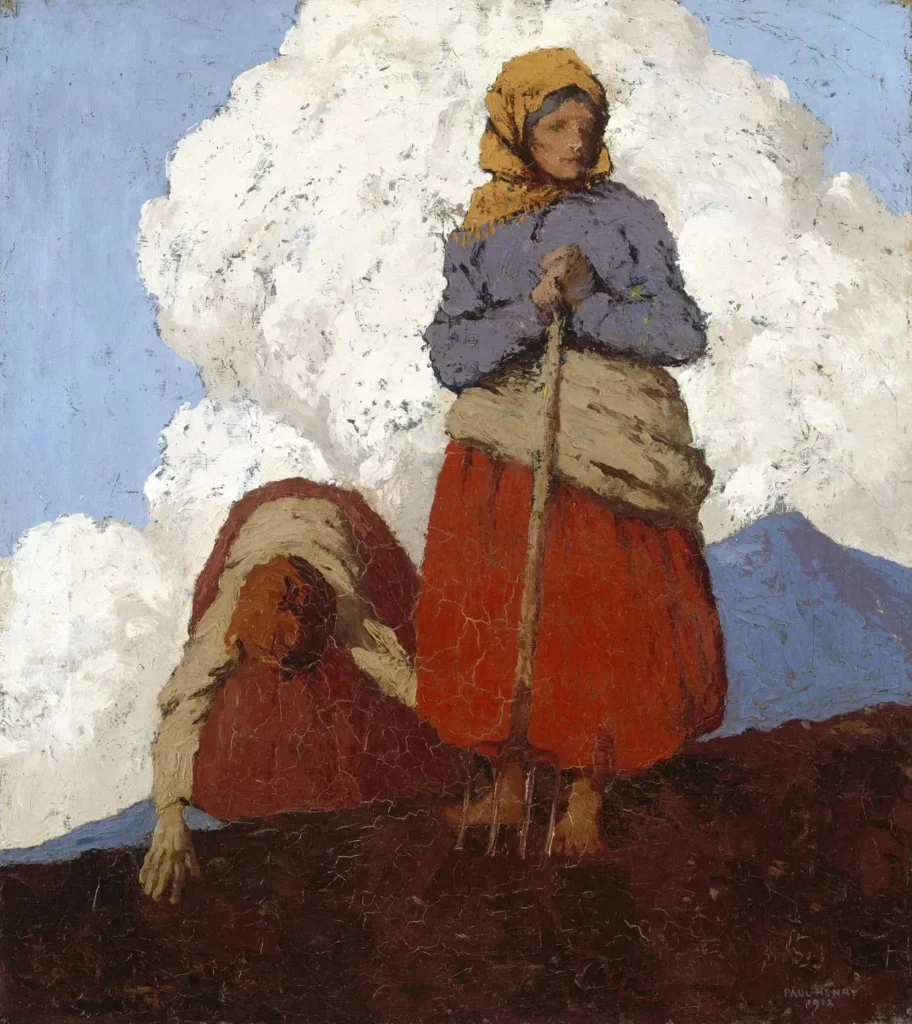
Paul Henry became famous for paintings of rural western Ireland, particularly scenes inspired by Achill Island. The Potato Diggers shows agricultural workers beneath a large and imposing sky.
Henry simplified both the figures and landscape into strong shapes and subdued colors. His distinctive approach became enormously influential in shaping popular visual representations of the Irish countryside during the twentieth century.
8. The Singing Horseman – Jack B. Yeats, 1949

By the later part of his career, Jack B. Yeats had moved far away from conventional realism. The Singing Horseman demonstrates his mature style through thick paint, vivid colors, and energetic brushstrokes.
The horse and rider seem almost to merge with the surrounding landscape. Instead of precise detail, Yeats uses color and movement to communicate emotion, freedom, and the exhilaration of the moment.
9. In a Dublin Park, Light and Shade (c. 1895) by Walter Osborne

Walter Osborne’s In a Dublin Park, Light and Shade captures an everyday scene in a Dublin park, with figures relaxing beneath trees as sunlight filters through the leaves. The painting reflects Osborne’s fascination with ordinary urban life and his ability to capture fleeting effects of natural light.
Influenced by Impressionism and plein-air painting, Osborne used loose brushwork and contrasts between sunlight and shadow to give the scene a lively, spontaneous quality. His paintings of Dublin provide an important visual record of the city and its people during the late nineteenth century.
10. Launching the Currach – Paul Henry, c. 1910–1911

Launching the Currach depicts figures preparing a traditional Irish boat along the western coastline. The people are small compared with the surrounding landscape and expansive sky.
This emphasis on nature became a hallmark of Henry’s work. His simplified mountains, dramatic clouds, and restrained colors created an instantly recognizable vision of western Ireland that remains closely associated with Irish landscape painting.