

Jackson Pollock was one of the leading figures of Abstract Expressionism and became famous for developing his distinctive “drip” technique.
Rather than painting conventionally at an easel, Pollock often placed large canvases on the floor and poured, dripped, flicked, and splattered paint across their surfaces.
His paintings range from early figurative and mythological works to the enormous abstract compositions that made him one of the most influential American artists of the 20th century.
Famous Jackson Pollock Paintings
1. Convergence

Convergence is one of Jackson Pollock’s most recognizable later paintings. Created in 1952, the enormous canvas is covered with an energetic network of black, white, red, yellow, and blue paint.
The composition has no obvious focal point. Instead, lines and splashes stretch across virtually the entire surface, creating the “all-over” effect associated with Pollock’s mature work. Although the painting can initially appear chaotic, its colors, overlapping marks, and changes in density create a surprising sense of balance.
Convergence demonstrates how Pollock turned the physical act of painting into an essential part of the finished artwork. The viewer isn’t presented with a recognizable scene but with a visual record of movement, rhythm, and repeated gestures.
2. Mural (1943)
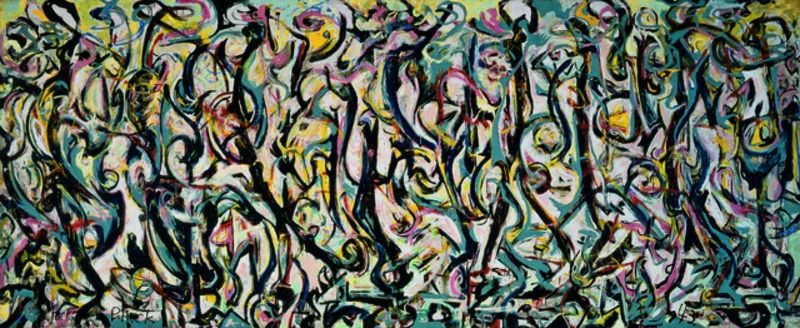
Mural represents a major turning point in Pollock’s development. The enormous painting was commissioned by art collector and patron Peggy Guggenheim for the entrance hall of her New York townhouse.
Although Pollock had not yet fully developed the drip technique for which he became famous, Mural already contains many features of his mature style. Sweeping lines and rhythmic forms move energetically across the enormous canvas.
Pollock reportedly described the imagery in terms of a stampede of animals moving across the American West, although the forms remain highly abstracted. The painting demonstrates his growing interest in creating compositions without a single traditional focal point.
Its monumental scale was particularly significant, helping Pollock move away from conventional easel painting toward the immersive canvases of the late 1940s and early 1950s.
3. Number 1 (Lavender Mist)

Despite its familiar nickname, surprisingly little lavender actually appears in Lavender Mist. The title was suggested by the influential art critic Clement Greenberg, while Pollock originally identified the painting simply as Number 1, 1950.
The large canvas is filled with intricate layers of white, black, gray, brown, and muted pinkish tones. Pollock poured and dripped paint across the surface, creating an extraordinarily dense web of overlapping lines.
There is no conventional foreground or background. Instead, the entire surface seems active, encouraging the viewer’s eye to move continuously around the composition.
Lavender Mist is considered a classic example of Pollock’s mature drip technique and the “all-over” approach that became closely associated with Abstract Expressionism.
4. No. 5, 1948

No. 5, 1948 is one of Pollock’s best-known drip paintings and became especially famous after attracting enormous prices in the private art market.
The painting consists of dense layers of brown, yellow, gray, white, and black paint applied to fiberboard. Pollock’s lines twist and overlap until they form an almost impenetrable network across the surface.
At first glance, the composition may appear completely spontaneous. Pollock’s working process, however, involved considerable control. He could vary the thickness of his lines by changing the speed of his movements, the consistency of the paint, and the distance between the paint and the surface.
The result captures the combination of spontaneity and control that makes Pollock’s drip paintings so distinctive.
5. Autumn Rhythm (Number 30)

Created during the height of Pollock’s drip-painting period, Autumn Rhythm (Number 30) stretches more than 17 feet across and surrounds the viewer with a vast network of painted lines.
Pollock placed the unstretched canvas on the floor of his studio and worked around it from multiple directions. Using sticks, brushes, and other tools, he poured and dripped paint directly onto the surface.
Black, white, brown, and tan lines repeatedly cross one another, creating areas of both extraordinary density and relative openness.
The word “rhythm” is particularly appropriate. Rather than depicting autumn literally, the painting suggests movement and natural energy through its constantly changing patterns.
Today, Autumn Rhythm is one of the defining works of American Abstract Expressionism.
6. One: Number 31, 1950

One: Number 31, 1950 is another monumental work from Pollock’s extraordinary creative period around 1950.
Measuring almost nine feet high and more than seventeen feet wide, the painting is large enough to dominate the viewer’s field of vision. Black, white, gray, brown, and blue lines weave across the canvas in a complex network.
Pollock worked from all sides of the painting while it lay on the floor. This allowed him to move physically through the space surrounding the canvas rather than approaching it from only one direction.
Despite the apparent spontaneity, the distribution of paint creates a sense of structure. Dense areas are balanced against more open sections, while different types of lines give the painting varying visual rhythms.
7. Blue Poles(Number 11)

Blue Poles stands apart from many of Pollock’s other drip paintings because of the prominent dark blue forms cutting diagonally across the composition.
Behind these “poles” is an intricate field of poured and splattered paint in numerous colors. The strong blue elements provide a degree of structure that is less obvious in some of Pollock’s earlier all-over compositions.
The painting became particularly famous after the National Gallery of Australia purchased it in 1973. The price generated considerable public debate at the time, but the painting subsequently became one of the best-known works in the museum’s collection.
Blue Poles shows Pollock continuing to experiment with his drip technique rather than simply repeating the formula of his earlier successes.
8. The She-Wolf

The She-Wolf provides a fascinating look at Pollock’s art before the development of his famous drip paintings.
Created in 1943, the work contains a roughly recognizable animal form surrounded by energetic lines, symbols, and areas of color. The exact meaning of the wolf remains uncertain, although the title has encouraged associations with the legendary she-wolf that nursed Romulus and Remus in Roman mythology.
Pollock was deeply interested in mythology, Indigenous art, psychology, and the work of European modernists during this period. These influences helped him move increasingly toward abstraction.
The She-Wolf is especially important because it demonstrates that Pollock’s interest in energetic lines and layered surfaces was already developing several years before his breakthrough drip paintings.
9. Number 1A, 1948

Number 1A, 1948 was created as Pollock’s revolutionary poured-painting technique was becoming fully established.
The surface contains layers of black, white, gray, and other colors, applied through dripping, pouring, and direct physical contact. Pollock even incorporated impressions from his own hands into the composition.
Those handprints make the painting particularly interesting because they provide a literal trace of the artist within an otherwise abstract image.
The work also illustrates why Pollock’s method eventually became associated with the term “action painting.” The movements involved in producing the artwork—walking around the canvas, pouring paint, changing direction, and making physical contact with the surface—became inseparable from the finished composition.
10. The Deep

The Deep is noticeably different from the dense networks of paint found in Pollock’s most famous works from 1948–1950.
Large areas of white dominate the composition, divided by an irregular dark form running through the center. Touches of other colors appear around the edges and within the surrounding paint.
The title inevitably encourages interpretation. The central darkness can resemble a crack, chasm, or opening into an unknown space, although Pollock’s abstract imagery prevents any single interpretation from being definitive.
Created in 1953, The Deep belongs to the later years of Pollock’s career, when his work was moving away from the classic drip paintings that had brought him international recognition. Its dramatic contrast and comparatively restrained composition demonstrate that Pollock continued experimenting with abstraction rather than remaining tied to one particular style.