

Cherubs, putti, and childlike angels appear throughout Renaissance, Baroque, and Rococo art.
Although the terms are often used interchangeably today, many of the familiar winged children in Western paintings are technically putti rather than biblical cherubim.
From Raphael’s instantly recognizable angels to the playful figures of Rubens and Boucher, here are ten famous artworks featuring cherub-like figures.
Famous Cherub Paintings
1. The Sistine Madonna – Raphael, 1512–1513

Raphael’s The Sistine Madonna contains perhaps the most famous cherubs in Western art. At the bottom of the composition, two small winged figures lean casually on a ledge and gaze upward.
Known as the Sistine Cherubs or Raphael’s Angels, they have become famous independently of the larger painting and have appeared on countless posters, cards, and decorative objects.
2. The Triumph of Galatea – Raphael, c. 1512

Raphael filled this mythological fresco with energetic figures, including winged putti flying through the sky. One aims an arrow toward Galatea, connecting the scene with themes of love and desire.
Their playful presence contributes to the movement and joyful atmosphere of this masterpiece of the High Renaissance.
3. Venus, Cupid, Folly and Time – Agnolo Bronzino, c. 1545
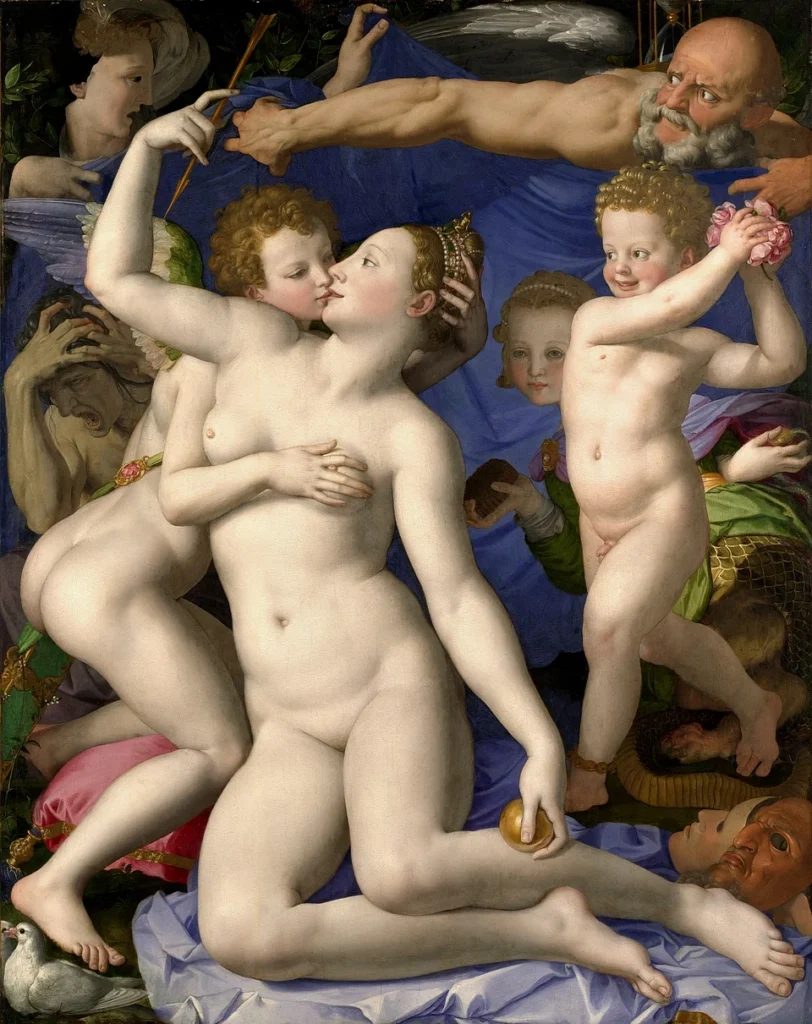
Also known as An Allegory with Venus and Cupid, Bronzino’s elaborate Mannerist painting is filled with symbolic figures associated with love, pleasure, deception, and time.
Cupid occupies a prominent position alongside Venus, while other youthful figures contribute to the painting’s deliberately complex and unsettling allegory.
4. The Feast of Venus – Peter Paul Rubens, 1636–1637

Rubens populated The Feast of Venus with an extraordinary number of playful putti and cupids. The small figures dance, fly, embrace, and interact throughout the crowded composition.
Inspired partly by ancient descriptions of celebrations honoring Venus, the painting is a spectacular Baroque celebration of love, fertility, and sensuality.
5. The Birth of Venus – François Boucher, 1740

Boucher’s interpretation of the birth of Venus is filled with the soft colors, graceful figures, and playful sensuality characteristic of Rococo painting.
Cherub-like putti accompany the goddess among swirling clouds and water, helping transform the mythological subject into an elaborate decorative fantasy.
6. The Toilet of Venus – François Boucher, 1751

In The Toilet of Venus, the goddess is surrounded by luxurious fabrics, flowers, doves, and playful winged putti.
Boucher’s pale blues, pinks, and creamy flesh tones create the elegant, dreamlike appearance associated with French Rococo art. The cherubs reinforce the painting’s themes of beauty, romance, and love.
7. The Triumph of Divine Providence – Pietro da Cortona, 1633–1639

This enormous Baroque ceiling fresco in Rome’s Palazzo Barberini is crowded with allegorical figures, clouds, divine beings, and flying putti.
The cherub-like figures help create the illusion that the ceiling has opened into an immense heavenly realm above the viewer.
8. The Assumption of the Virgin – Correggio, 1526–1530

Correggio’s spectacular dome fresco in Parma Cathedral shows the Virgin Mary ascending toward heaven surrounded by a swirling multitude of angels and heavenly figures.
Numerous youthful angels contribute to the extraordinary sensation of movement, making the architecture seem to disappear into an open sky.
9. The Apotheosis of St. Ignatius – Andrea Pozzo, 1685–1694

Painted across the ceiling of the Church of Sant’Ignazio in Rome, Pozzo’s monumental fresco creates a remarkable illusion of an endless heavenly space.
Angels and cherub-like figures float among clouds and saints, while Pozzo’s mastery of perspective makes the painted architecture appear to continue far beyond the actual ceiling.
10. The Swing – Jean-Honoré Fragonard, 1767

Fragonard’s The Swing is one of the defining masterpieces of the Rococo period.
Although the romantic scene centers on a young woman swinging above her hidden admirer, a sculpted cupid watches from the garden and raises a finger to its lips.
The cupid becomes an important symbol of secrecy, flirtation, and forbidden love.