

Thanksgiving has inspired artists to capture family gatherings, abundant feasts, harvest traditions, and moments from American history.
From Norman Rockwell’s iconic Freedom from Want to historical scenes of the first Thanksgiving, these works reveal how artists have portrayed the holiday and its traditions through the years.
Here are 8 famous Thanksgiving paintings and the stories behind them.
Famous Thanksgiving Paintings
1. Freedom from Want — Norman Rockwell, 1943

Norman Rockwell’s Freedom from Want is probably the most recognizable Thanksgiving image in American art.
Painted in 1943 as part of Rockwell’s celebrated Four Freedoms series, it shows a large family gathered around a dining table as an elderly couple presents a beautifully roasted turkey.
Although Rockwell did not specifically title the work as a Thanksgiving scene, its turkey dinner, family gathering, and atmosphere of abundance have made it closely associated with the holiday.
The painting was inspired by President Franklin D. Roosevelt’s idea of “freedom from want” and presents an optimistic vision of security, prosperity, and togetherness during World War II.
2. Thanksgiving Turkey — Grandma Moses, 1943

Grandma Moses became famous for nostalgic paintings depicting rural American life, particularly farms, villages, seasonal celebrations, and traditional customs.
Thanksgiving Turkey reflects the importance of food and harvest traditions in American Thanksgiving celebrations. Her distinctive folk-art approach uses simplified figures, bright colors, and storytelling details rather than realistic perspective.
Works such as this helped establish Grandma Moses as one of the best-known American folk artists of the twentieth century.
3. Thanksgiving — Doris Lee, 1935

Doris Lee’s Thanksgiving presents the holiday as a lively and slightly chaotic family occasion rather than an idealized formal dinner.
The scene is filled with people preparing food, talking, working, and moving around a busy kitchen and dining area.
Lee’s humorous treatment of everyday life made the painting memorable, but it was controversial when first exhibited because some critics disliked its intentionally exaggerated figures.
Today, the work is regarded as an important example of American Scene painting and offers a wonderfully energetic interpretation of Thanksgiving.
4. Thanksgiving — John Currin, 2003

John Currin’s Thanksgiving offers a much more contemporary interpretation of the traditional feast. The painting depicts three women gathered around a table filled with food and elaborate tableware.
Currin combines techniques and compositions reminiscent of European Old Master paintings with deliberately exaggerated modern figures.
Rather than simply portraying a comfortable family Thanksgiving, the work plays with ideas of abundance, beauty, artificiality, tradition, and excess.
5. The First Thanksgiving at Plymouth — Jennie Augusta Brownscombe, 1914

Jennie Augusta Brownscombe’s The First Thanksgiving at Plymouth is one of the best-known artistic representations of the traditional story of the first Thanksgiving.
The painting depicts English colonists and Native Americans gathered outdoors for a shared meal at Plymouth.
Created almost three centuries after the event it portrays, the work reflects an early twentieth-century interpretation rather than an eyewitness record.
Nevertheless, it became highly influential in shaping popular American imagery surrounding the Pilgrims and Thanksgiving.
6. Home to Thanksgiving — Norman Rockwell, 1945
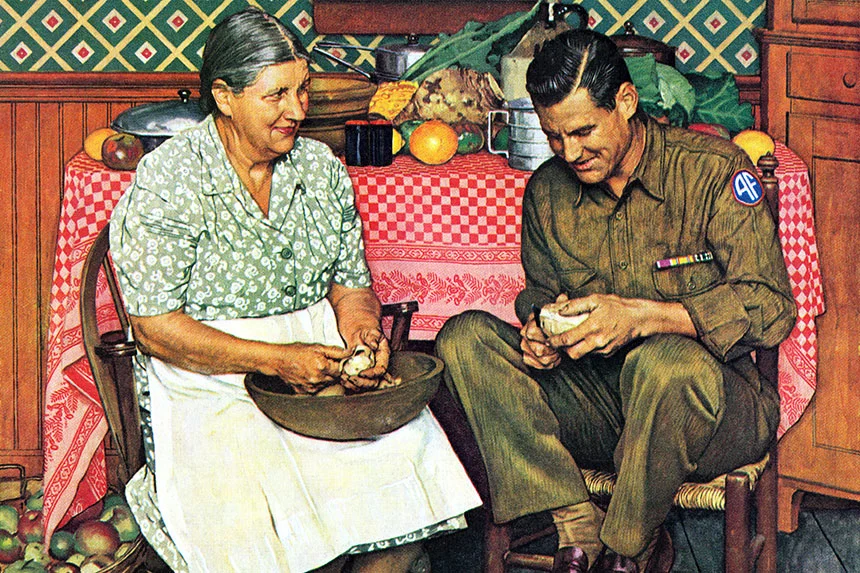
Norman Rockwell frequently used family life and American traditions as subjects for his illustrations. Home to Thanksgiving focuses on the idea of returning home and helping prepare for the holiday.
Rather than concentrating entirely on the Thanksgiving feast itself, Rockwell emphasizes the relationships between family members and the small domestic moments surrounding the celebration.
The image reflects the warmth, humor, and carefully observed everyday details for which Rockwell became famous.
7. Thanksgiving Picture — Roy Lichtenstein, 1961

Roy Lichtenstein became one of the leading figures of the Pop Art movement, transforming imagery associated with advertising, comic books, consumer products, and popular culture into fine art.
Works from the beginning of the 1960s were especially important in his transition toward the distinctive Pop Art style for which he became famous.
Thanksgiving imagery viewed through this modern approach provides a sharp contrast to the nostalgic scenes associated with artists such as Rockwell and Grandma Moses.
8. Thanksgiving — Horace Pippin, 1942

Horace Pippin was a self-taught African American painter whose work frequently explored domestic life, history, religion, war, and the experiences of Black Americans.
His paintings are known for their strong shapes, carefully arranged compositions, and distinctive sense of storytelling.
Domestic scenes were particularly important within his work, transforming seemingly ordinary moments into thoughtful observations of family and everyday American life.