

Sunflowers have inspired some of the world’s most famous artists, drawn to their brilliant yellow petals, dramatic shapes, and associations with warmth and summer.
From Vincent van Gogh’s iconic Sunflowers to works by Claude Monet, Gustav Klimt, and Diego Rivera, artists have interpreted these striking flowers in remarkably different ways.
Here are 10 famous sunflower paintings that show how one simple subject can inspire everything from Impressionism to modern art.
Famous Sunflower Paintings
1. Sunflowers – Vincent van Gogh (1888)

Vincent van Gogh’s Sunflowers is undoubtedly the most famous depiction of sunflowers in Western art. Painted in Arles in southern France, the work shows a simple vase overflowing with yellow and golden flowers against a similarly warm background.
Van Gogh created several sunflower paintings, experimenting with different stages of the flowers’ life cycle. Some blooms are fresh and full, while others have begun to droop and lose their petals. His thick, expressive brushstrokes give the petals and seed heads an almost sculptural appearance.
The paintings were originally intended to decorate the Yellow House, where Van Gogh hoped to establish an artistic community. Today, the sunflower series has become one of the defining achievements of Post-Impressionism and an enduring symbol of Van Gogh himself.
2. Bouquet of Sunflowers – Claude Monet (1881)

Claude Monet painted Bouquet of Sunflowers in 1881, several years before Van Gogh created his celebrated sunflower series. The painting presents a generous arrangement of yellow sunflowers placed in a decorative vase.
Rather than carefully defining every petal, Monet used loose, visible brushstrokes to capture the overall impression of the flowers. Brilliant yellows and oranges stand out against the darker background, giving the bouquet a warm glow.
The painting demonstrates how Impressionist techniques could be applied to still life as effectively as landscapes. Van Gogh reportedly admired Monet’s sunflower painting, making it an interesting predecessor to his own experiments with the subject.
3. Sunflower – Gustav Klimt (1907)
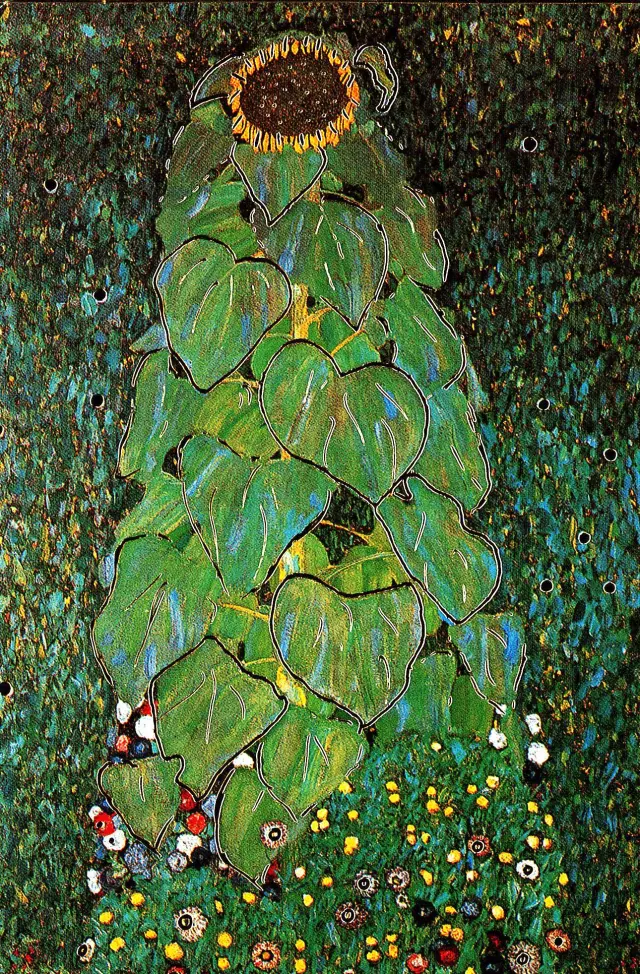
Gustav Klimt’s The Sunflower presents the flower in a remarkably unusual way. Instead of depicting a bouquet in a vase, Klimt shows a single towering sunflower emerging from a dense garden filled with leaves and smaller flowers.
The tall, narrow shape of the sunflower has often been compared to a human figure. Its large flower head appears almost like a face, while the surrounding leaves create the impression of an elaborate green garment.
Klimt’s decorative approach turns the natural scene into a rich pattern of shapes and colors. Created during his celebrated Golden Period, the painting demonstrates his ability to combine observation of nature with the ornamental qualities for which he became famous.
4. Sunflowers – Paul Gauguin (1901)

Paul Gauguin returned to the subject of sunflowers late in his career while living in French Polynesia. His sunflower still lifes reveal the continuing influence of Van Gogh, with whom Gauguin had famously lived and worked in Arles in 1888.
Unlike a conventional floral arrangement, Gauguin’s sunflowers are painted with simplified shapes, strong outlines, and areas of intense color. The composition feels flatter and more decorative than the naturalistic flower paintings of earlier generations.
The subject also provides an intriguing connection between two major Post-Impressionist artists. Although their friendship ended badly, Gauguin continued to engage with themes associated with Van Gogh years after their dramatic period together in Arles.
5. Sunflowers – Emil Nolde (c. 1926)

German-Danish Expressionist Emil Nolde had a deep fascination with flowers and gardens. Sunflowers were particularly suited to his dramatic style because their large flower heads and brilliant colors allowed him to experiment with bold contrasts.
Nolde rarely attempted to reproduce flowers with botanical precision. Instead, he intensified their yellows, oranges, reds, and greens, allowing color to communicate the energy and atmosphere of the plants.
His sunflower paintings can appear almost wild compared with traditional flower still lifes. Thick paint and expressive brushwork transform the familiar garden flower into something vivid, emotional, and distinctly Expressionist.
6. Sunflowers – Egon Schiele (1911)

Egon Schiele approached sunflowers very differently from Van Gogh or Monet. Rather than emphasizing their brightness and abundance, Schiele often depicted plants that appear thin, fragile, or close to decay.
His elongated stems and drooping flower heads give the plants an almost human quality. Against relatively simple backgrounds, every twisting leaf and stem becomes highly noticeable.
Schiele frequently explored themes of mortality, transformation, and the passage of time. His sunflower paintings fit naturally within this interest, showing that flowers could represent vulnerability and decline just as effectively as beauty and growth.
7. Sunflowers – Joan Mitchell (1969)

Joan Mitchell brought the sunflower into the world of Abstract Expressionism. Rather than creating a recognizable botanical study, she used the flower as inspiration for energetic arrangements of color, line, and gesture.
Mitchell was deeply interested in landscapes, gardens, and memories of nature. Her paintings often began with something she had seen or experienced before becoming increasingly abstract as she worked.
In her sunflower-inspired works, sweeping brushstrokes suggest the movement and intensity of plants without describing every flower precisely. The result is less a picture of sunflowers than an emotional response to their color and presence.
8. Sunflowers – David Hockney (1996)

David Hockney has frequently returned to flowers and still-life subjects throughout his long career. Sunflowers fit naturally into his work because their bold shapes and intense yellows complement his distinctive approach to color.
Rather than attempting photographic realism, Hockney often simplifies flowers into clear shapes and confident lines. Everyday objects such as tables, vases, and domestic interiors can become part of the composition.
His flower pictures demonstrate how a traditional subject can continue to inspire contemporary artists. In Hockney’s hands, the familiar sunflower becomes bright, modern, and immediately recognizable.
9. Sunflowers – Diego Rivera, 1943

American painter Maria Oakey Dewing became particularly admired for her refined paintings of flowers and gardens. Working around the turn of the 20th century, she treated flowers as serious artistic subjects rather than simply decorative additions.
Her approach was generally more delicate than the expressive sunflower paintings associated with Van Gogh or Nolde. Careful observation of petals, stems, and leaves allowed her to create graceful compositions with a strong sense of natural beauty.
Dewing’s floral paintings also reflect the growing importance of women within American art during this period. Her work helped elevate flower painting while establishing her reputation as an accomplished artist in her own right.
10. Sunflowers – Edward McKnight Kauffer, c. 1917

Edward McKnight Kauffer’s Sunflowers offers a more modern interpretation of the familiar flower. Kauffer was an American-born artist who spent much of his career in Britain and became particularly well known for his innovative graphic design and poster work.
In Sunflowers, the natural forms of the flowers are simplified into bold shapes and strong areas of color. Rather than concentrating on botanical detail, Kauffer emphasizes pattern, structure, and the visual rhythm created by the leaves, stems, and flower heads.
The painting provides an interesting contrast with the sunflowers of Van Gogh, Monet, and Gauguin. It shows how artists of the early 20th century increasingly transformed traditional subjects into experiments with shape, color, and modern design.